

























Nigeria’s latest Gross Domestic Product (GDP) report for the third quarter of 2025 indicates that the economy grew by 3.98 percent in real terms. Although this reflects a slight moderation from the 4.3 percent growth recorded in the second quarter, the data confirms that the economy remains firmly on a path of steady recovery and consolidation.
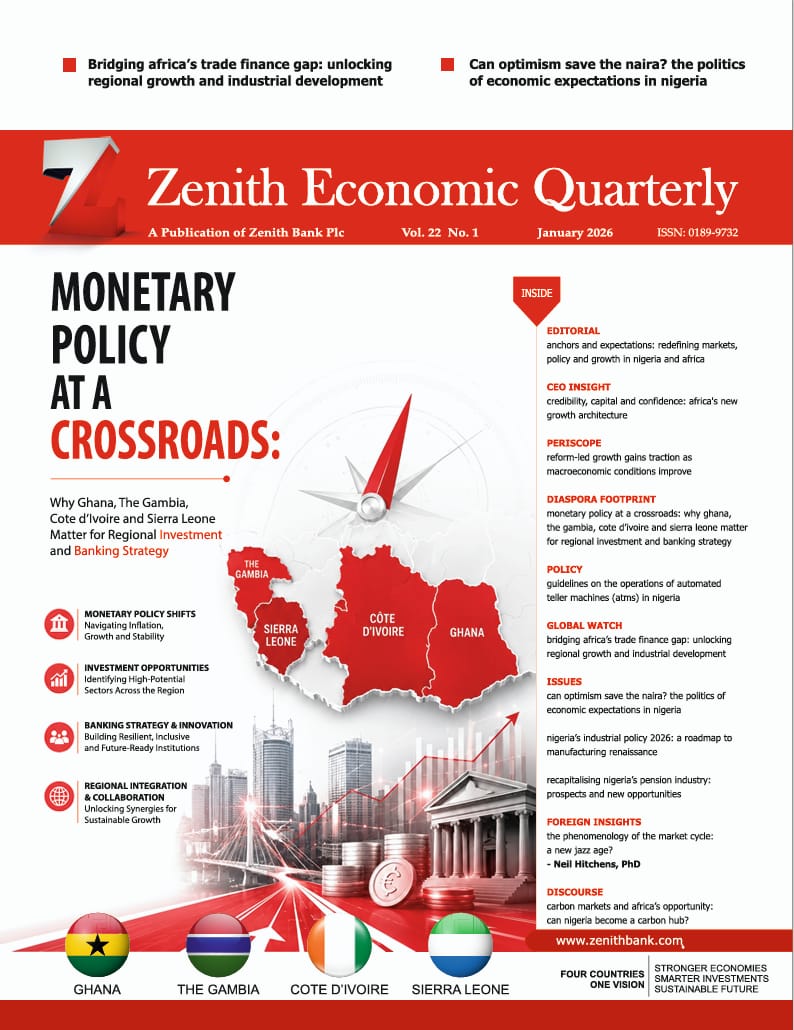 https://www.digital.zenithbank.com/ZEQ/ZEQ-jan-2026/index.html#p=1
The Q3 performance highlights the positive impact of ongoing economic reforms, especially in stabilising the exchange rate, moderating inflation, improving fiscal conditions, and gradually restoring investor confidence. These macroeconomic gains have strengthened business sentiment and supported activity across key sectors of the economy.
However, despite improving fundamentals, the cost-of-living crisis remains a concern. While disinflation is underway and prices of some food items and manufactured products are easing, the social outcomes of economic reforms continue to weigh on households. It is therefore imperative for policymaking to prioritise targeted interventions to address the uneasiness around the cost of living and ensure that GDP Growth and macroeconomic stability translate into real improvements in citizens’ welfare—particularly for vulnerable groups.
Macroeconomic Stability Bolstering Growth
The sustained recovery recorded in Q3 is largely supported by:
- Greater exchange rate stability resulting from FX market reforms;
- Decelerating inflation, easing cost pressures on households and businesses;
- Improved investor confidence, reinforcing growth in financial services, ICT, construction, and other segments of the services sector.
These developments demonstrate that the government’s reform programme is beginning to generate tangible and measurable outcomes across the economy.
Sectoral Developments
Services Sector: The Dominant Growth Driver
The services sector maintained its position as the largest contributor to GDP, accounting for 53 percent of total output. Its continued resilience—supported by digital adoption, financial services expansion, and improved business confidence—remains central to overall economic performance.
Agriculture: Moderate Recovery Amid Structural Constraints
Agriculture grew by 3.79 percent, up from 2.82 percent in Q2. Despite this modest improvement, insecurity in farming communities, weak rural logistics, limited mechanisation, and declining purchasing power continue to constrain full-scale recovery.
Manufacturing: Still Fragile and Under Pressure
Manufacturing expanded by 1.25 percent, one of the weakest performances across major sectors. Persistent challenges include:
- High energy and logistics costs;
- Costly borrowing conditions;
- Dependence on imported industrial inputs;
- Smuggling of competing products.
These structural weaknesses continue to erode competitiveness and limit job creation.
ICT: A Key Non-Oil Growth Anchor
The ICT sector grew by 5.78 percent, slightly below its Q2 growth of 6.6 percent. Nonetheless, the sector remains one of the economy’s strongest performers, driven by rapid digitalisation, e-commerce expansion, and increased technology adoption by households and businesses.
Real Estate: Strong Nominal Growth, Worsening Affordability
Real estate posted an exceptional 89 percent nominal GDP growth, fuelled by rising property values and asset revaluation. While favourable for investors in the sector, this trend intensifies housing affordability challenges, especially in major cities. Land administration reforms and affordable housing initiatives have become urgent.
Financial Services: Strongest Performer in Q3
Financial services emerged as the best-performing major economic sector, expanding by 19.63 percent, up from 6.13 percent in Q2. This reflects increased economic activity, stronger fiscal operations across all levels of government, and rising confidence in the financial system.
Trade Sector: Slow and Fragile Recovery
The trade sector grew by 1.98 percent, up from 1.29 percent in Q2. High import costs, weak consumer demand, and ongoing import-substitution measures continue to constrain growth. Nevertheless, Nigeria has recorded consistent trade surpluses, bolstering the balance of payments.
Social Sectors: Recovery Still Limited
Education and health grew by 2.51 percent and 2.89 percent, respectively. These modest gains reflect under-investment, underscoring the need for expanded public spending and stronger governance across social services.
Sectors in Recession and Those Losing Momentum
- The textile and apparel sector remained in recession, contracting by 2.41 percent, mainly due to high production costs and smuggling.
- The paper and pulp sector also contracted by 1.07 percent.
- Several other sectors—including crude petroleum and gas, manufacturing, real estate, ICT, cement, transportation, iron and steel, rubber and plastics, and food and beverages—showed slower growth compared to the previous quarter.
Conversely, sectors such as financial services, oil refining, pharmaceuticals, construction, auto assembly, broadcasting, entertainment, education, and health recorded accelerated growth, albeit from relatively low bases.
Policy Imperatives for Sustaining Recovery
To consolidate the gains recorded in Q3 and unlock stronger, more inclusive growth, the following policy interventions are critical:
- Reduce Structural Bottlenecks
Address energy supply constraints, reduce logistics costs, improve port efficiency, and accelerate transport infrastructure development. - Mitigate the Cost-of-Living Crisis
Implement targeted social interventions and remove structural impediments that elevate consumer prices. All tiers of government [local, state and federal] must sustain targeted interventions in agriculture, pharmaceuticals, transportation and energy to fix the cost of living crisis. - Strengthen Agricultural Productivity
Improve security in farming regions, expand irrigation and storage facilities, invest in rural road networks, and support mechanisation. - Rebuild Manufacturing Competitiveness
Expand access to concessionary credit, curb smuggling, reduce import duties on industrial inputs, ease logistics challenges and address supply chain pressures. - Address Housing Affordability
Reform land administration, deepen mortgage markets, and scale up affordable housing initiatives. - Increase Funding for Social Sectors
Prioritise investments in education and health, strengthen partnerships with private sector players, and enhance governance of service delivery systems. - Enhance Non-Oil Export Competitiveness
Support exporters with reduced financing and production costs, and strengthen export logistics, certification, and standards. - Stabilise Oil Output and Secure Critical Infrastructure
Improve security in oil-producing regions, curb vandalism and theft, and incentivise new investments in upstream and gas-based industries.
Conclusion
Nigeria’s Q3 GDP performance reaffirms that the economy is on a gradual but steady recovery path, supported by improved macroeconomic stability, stronger investor sentiment, and resilience across key sectors such as services, ICT, financial services, chemical and pharmaceutical and construction.
However, achieving higher, more inclusive, and sustainable growth will require tackling long-standing structural constraints—especially in agriculture, manufacturing, and trade. Targeted policies to ease cost-of-living pressures are crucial to making the reform process inclusive.
With continued reforms, targeted investments, and strengthened governance, Nigeria is well-positioned to deliver stronger economic outcomes in the months ahead.